
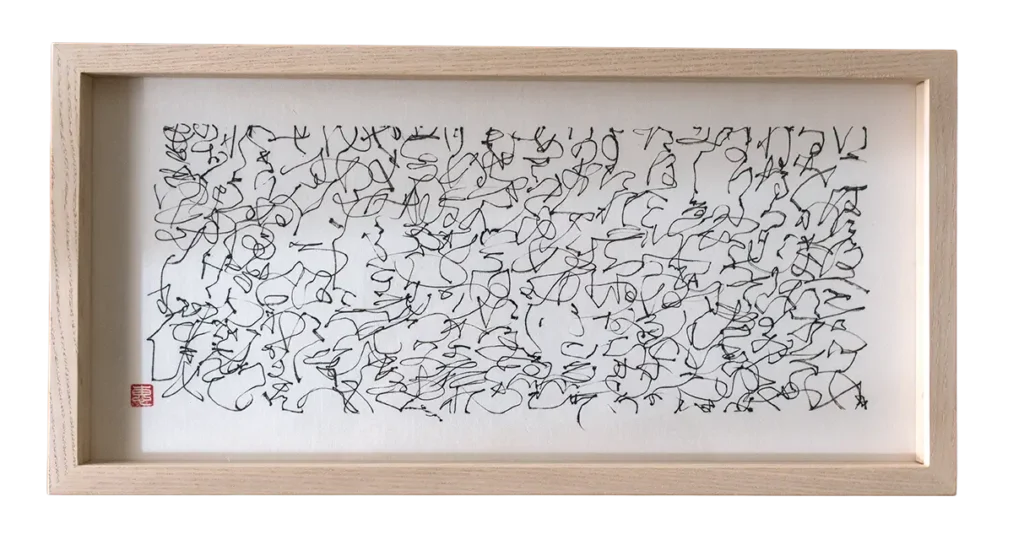
Iroha (or Iroha Song) is an ancient Japanese poem that functions as a perfect pangram, containing every character of the Japanese phonetic alphabet (kana) exactly once.
Composed during the Heian period (794–1185), it consists of 47 hiragana characters, including archaic forms such as wi (ゐ) and we (ゑ) no longer used in modern Japanese. The structure follows a rhythmic 7-5 syllable meter known as Imayō, a form of lyrical verse that was sung rather than recited, which transformed the entire syllabary into a song that could be easily memorised.
Traditionally attributed to the Buddhist monk Kūkai (空海) (774–835 CE), though modern research places its composition in the 10th or 11th century, the poem is a quiet meditation on the Buddhist concept of transience.
Read as a continuous poem of seven lines (five lines of seven syllables, two of five), it translates loosely to:
Translation: “Colour and scent, how they bloom, yet scatter…In this world of ours, who could remain unchanged? Today we cross the deep mountains of illusion,And leave behind shallow dreams and intoxication.”
Meaning: Fragrant flowers eventually scatter, reflecting how nothing in human life remains unchanged. The speaker resolves to cross the deep mountains of illusion towards clarity, free from shallow dreams and delusion.
Here is the breakdown of what’s written:
| Romaji / Syllables | Hiragana Script | Literal English Translation | Objective Meaning of the Text |
|---|---|---|---|
| I-ro-ha-ni-ho-he-to / Chi-ri-nu-ru-wo | いろはにほへと / ちりぬるを | Although flowers are fragrant, they scatter and fall. | Physical elements in nature change and do not last. |
| Wa-ka-yo-ta-re-so / Tsu-ne-na-ra-mu | わかよたれそ / つねならむ | In our world, who or what can remain unchanging? | Human life and society are subject to the same constant change as nature. |
| U-wi-no-o-ku-ya-ma / Ke-fu-ko-e-te | うゐのおくやま / けふこえて | Today, I cross over the deep mountains of fleeting reality. | The speaker passes through the illusions and difficulties of the physical world. |
| A-sa-ki-yu-me-mi-shi / We-hi-mo-se-su | あさきゆめみし / ゑひもせす | I shall see no more shallow dreams, nor be intoxicated by them. | The speaker reaches a state of clarity, refusing to be deceived by temporary distractions. |
Similar in function to the ABC song in Western culture, the Iroha was used in traditional Japanese education to teach the syllabary, helping children learn hiragana by singing along.
| Feature | The Iroha Song | The Alphabet Song |
|---|---|---|
| Origin Direction | Text → Melody (Poetry set to music) | Melody → Text (Music used to trap symbols) |
| Syllabic Rhythm | Natural 7-5 literary cadence | Forced musical grouping (e.g. “L-M-N-O-P”) |
| Modern Adaptation | Reimagined as vocal ballads and contemporary pop songs | Kept as a nursery rhyme or comedic parody |
It served as the core text for literacy in temple schools and continues to form the basis of Iroha Karuta, a traditional Japanese card-matching game.
In modern Japan, the Iroha sequence is still used to label legal subsections, traditional theatre seating, musical notes, and many art forms, including calligraphy.
Denmeg’s hiragana collection (Iroha) features original brushstroke calligraphy rooted in this classical poetry tradition.