
Tanka, “short song”, is one of Japan’s oldest structured poetic forms. Like haiku, it follows a fixed rhythmic structure, built on a 5-7-5-7-7 pattern of sound.
Originating over 1,300 years ago in the imperial courts.
On the other hand, haiku focuses on the natural world and a direct connection to life, tanka provides a broader framework for exploring the relationship between the external world and internal thought.
How Tanka Evolved
Tanka is a form of waka, Japan’s traditional fixed-form poetry. There are two distinct eras in history.
From 710 until 1860, the poetry of the Imperial Court was known as waka: a courtly practice governed by restrictive codes and idealised vocabulary. In the Nara period (710), the earliest anthologies of Japanese poetry were compiled, establishing waka as the defining art of the aristocracy.
Poets were expected to write within strict limits, using approved subjects and enhanced words.
Following the modernisation of the 1860s, reformers such as Japanese poet Masaoka Shiki revived the term tanka to distinguish a new approach from the formality of classical waka. Everyday language and the sincere expression of ordinary feeling became the foundation of the form.
The 31-sound structure remained, but thematic and emotional freedom replaced the restrictions of the court. Modern tanka is structured in form.
Aesthetics and Philosophy
The guiding principle of modern tanka is “illustrating from life”: direct, sensory observation of the everyday world, documented with complete honesty.
This philosophy inspires poets to draw from ordinary events rather than restricted formal poetic subjects.
Another concept is to describe a gentle awareness of the transience of things, aligning the fleeting nature of the physical world with the fleeting nature of human life and emotion.
Tanka specifically captures fleeting moments, such as the cooling of a kettle or the falling of a blossom, to reflect the fleeting moment of human experience.
Conparison Haiku vs Tanka
| Feature | Tanka (Short Song) | Haiku |
| Structure | Consists of 31 phonetic sounds arranged in a 5-7-5-7-7 cadence | Consists of 17 phonetic sounds arranged in a 5-7-5 pattern |
| Primary Focus | Explores human relationships, internal emotions, and the passage of time | Focuses strictly on an objective snapshot of nature or a fleeting moment |
| Perspective | Explicitly demands the author’s internal voice and subiective reflection | Deliberately removes the author’s personal psychology to maintain objectivity |
| Composition | Divided into two sections (the upper and lower phases) with a structural turn | Functions as a single, descriptive observation without an emotional resolution |
| Historical Role | The foundational form used for court rituals and intimate communication for 1,300 years | A later evolution that gained independence from the tanka’s opening lines |
Structure and Composition
A traditional tanka consists of 31 phonetic sounds. In Japanese, these are strictly timed units called morae, which differ from English syllables in that each mora is uniform in length. The poem follows a 5-7-5-7-7 rhythmic cadence.
| Section | Phase (Japanese) | Sound Count | Primary Purpose |
| Upper Poem | Kami-no-ku | 5-7-5 | Objective observation of a physical setting or moment in nature |
| Lower Poem | Shimo-no-ku | 7-7 | Subjective emotional response or personal reflection |
How to Compose a Tanka in English
- Notice a specific, tangible moment from daily life.
Capture a concrete occurrence or everyday event that triggered an authentic feeling. Avoid grand abstractions; look for the “free feelings” found in ordinary reality. - Draft the Upper Section.
Use the first three lines to establish the external scene using sensory imagery. - The Structural Turn.
At the end of the third line, introduce the turn. This is the bridge where the focus shifts from the environment to an internal reaction. - Draft the Lower Section.
Conclude with two lines to voice the honest emotion sparked by the initial scene. - Refine the Rhythm by Simplifying.
Read the poem aloud to ensure a timed, song-like cadence, removing unnecessary adjectives to preserve the precision. Let the imagery and the emotion stand together without an explicit narrator stripping decoration off, and see what comes up.
Modern tanka poets often adopt a five-line approach that prioritises the emotional turn over a rigid 31-sound count. In the original Japanese, the 31 characters are traditionally written in a single vertical line, creating a direct connection between the narrator and the reader.
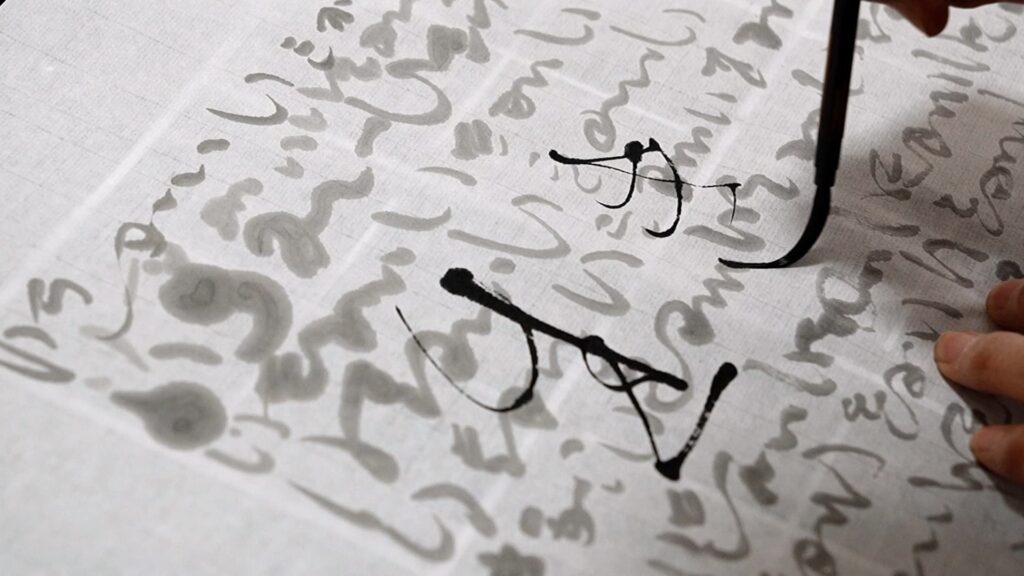
The artworks featured in the collection are composed in shodo, the traditional calligraphy discipline that expresses tanka in an art form.
Here is how tanka takes wearable form, See the Denmeng’s Tanka Collection